
Author:
Australian Institute of Health and Welfare
Released:
29 July 2026
Topic:
Cat. no:
GEN 002
Summary
This report describes the elapsed time between a person’s approval for selected aged care services (a home care package, permanent residential aged care, or both) and receipt of the service at the approved level. The cohort of interest includes everyone who had their first comprehensive aged care eligibility assessment in the 2021–22 financial year, followed up to 30 June 2024. This report also investigates the demographic and clinical factors associated with elapsed times for this cohort.
Key Findings
Background and Introduction
While Australian aged care services and programs have been regularly reformed to meet the care needs of the population, there are areas where needs may not be met. One source of unmet need, documented in the Royal Commission into Aged Care Quality and Safety’s Final Report (2021), is timeliness and equity in access to services, including variation in the amount of time people wait to access aged care. With increasing demand for home care services, there is ongoing community concern about the amount of time Australians are waiting to receive aged care services.
Some of the time that elapses between approval for care and receiving that care may be elective, where the person chooses not to or is unable to take up care when it is offered. However, prolonged waiting time due to system or service-level barriers to care can cause distress, lost work income for the person’s family members, and increased carer burden (McCallum et al. 2018). A study found that prolonged waiting times for home care packages were associated with a higher risk of long-term mortality as well as transition to permanent residential aged care (Visvanathan et al. 2019). Understanding waiting times, the factors that are associated with longer waiting time, and how these have changed over time and with aged care reform, can help to target policy and quality improvement initiatives.
The analytical methods used in the previous report were applied to produce this report, but using more recent data – namely the Pathways in Aged Care (PIAC) 2024 link map (see Technical notes) which is part of the National Aged Care Data Clearinghouse (NACDC). Using linked data allows for analysis of elapsed times while following individuals across multiple service types, building a clearer picture of the pathways people take through the aged care system.
This report presents analysis of data for people who had their first comprehensive assessment and were approved for a home care package or permanent residential aged care (or both) in the 2021–22 financial year. Service outcomes are reported up to 30 June 2024 along with median elapsed times between date of assessment approval and date of receipt of a service at the approved level. Results of analysis are also presented that measure the association of demographic and clinical factors with shorter or longer elapsed times within the study cohort.
The Australian aged care system offers a continuum of care with 3 main types of service:
- Home support – Commonwealth Home Support Program (CHSP) and its pre-2015 predecessor Home and Community Care (HACC) – which provides entry-level services focused on supporting individuals to undertake tasks of daily living to enable them to be more independent at home and in the community
- Home care, which is a more structured, more comprehensive package of home-based support. The Home Care Packages program was provided over 4 levels ranging from basic care (Level 1) to high care (Level 4) needs. This program was replaced by Support at Home on 1 November 2025.
- Residential aged care, which provides support and accommodation for people who have been assessed as needing higher levels of care than can be provided in the home. Residential care is provided on either a permanent or a temporary (respite) basis.
There are also several types of flexible care, and services for specific population groups, available that extend across the spectrum from home support to residential aged care. The focus of this report is on Home Care Packages and permanent residential aged care. For more information on the full range of aged care services in Australia see the Report on the Operation of the Aged Care Act or visit the Department of Health, Disability and Ageing website.
In 2021-22 there were two assessment types to determine whether an older person was eligible for government-subsidised aged care: comprehensive assessments and home support assessments.
- Home support assessments were generally conducted face-to-face by Regional Assessment Service (RAS) assessors. These assessors provide evaluation, information, and advice to individuals needing low-level support and determine eligibility for the Commonwealth Home Support Programme (CHSP).
- Comprehensive assessments for aged care services were conducted to determine a person’s care needs and eligibility to receive selected Australian Government-subsidised aged care services, including permanent residential aged care and home care packages. Assessments were conducted by Aged Care Assessment Teams (ACAT) which operated in all states and territories.
From 1 July 2024, the Integrated Assessment Tool (IAT) replaced the National Aged Care Screening and Assessment Form (NSAF), and from 9 December 2024 the Single Assessment System workforce replaced the split RAS (home support), ACAT (comprehensive) assessment organisations and independent Australian National Aged Care Classification (AN-ACC) assessors (residential aged care). Please refer to the Department’s website for more details.
In this report, ‘receipt of approved care service’ was defined according to the type of service for which a person was approved in their first comprehensive assessment.
- For people approved for permanent residential aged care only, receiving their approved service occurs when they begin living in permanent residential aged care.
- For people approved for a home care package only, receiving their approved service occurs when they begin receiving a home care package at the level for which they were approved.
- For people approved for both a home care package and permanent residential aged care, receiving their approved service occurs when they begin receiving a home care package at the level for which they were approved, OR they begin living in permanent residential aged care (whichever occurs first).
In this report, due to the limitations in the home care package data, the date for receipt of approved home care package is based on the date on which the provider was funded to deliver the approved level of care, rather than the actual start date of that care. This presents the shortest possible elapsed time for the care recipient. For more information on the data sources and their limitation, please see the Technical notes.
The time between receiving an approval for care and taking up that care can vary. After a person receives approval for a care service they may:
- receive the service at the approved level,
- receive an ‘interim’ care service for which they are also approved (that is, a lower-level service until a service at the approved level becomes available),
- choose not to receive care when it is offered to them,
- receive another comprehensive assessment and approval for a different service, including moving to permanent residential aged care when not initially approved for permanent residential aged care,
- die.
Other factors that may impact on the elapsed time between approval and receiving care include waiting for a service to become available and organising financial arrangements necessary to accept care.
Service Outcomes
Key messages
Among the cohort of around 118,100 individuals with an approval for either a home care package only, permanent residential aged care only, or both, in 2021–22:
- 79% had received their approved service and around 15% had received home support only by 30 June 2024.
- 96.5% of individuals had received an aged care service of some kind, including home support, on or before 30 June 2024.
- Close to 2,600 people (2.2%) died before receiving an aged care service prior to or on 30 June 2024.
- Around 1,600 people (1.3%) were alive and did not receive a home care package, permanent residential care or home support by 30 June 2024.
During the analysis period, notable events that likely affected care availability and individual preferences to take up aged care included releases of additional home care packages by the Australian Government (Figure 1).
Figure 1 - Project timelines, key events and select government actions in aged care, 2021 to 2024
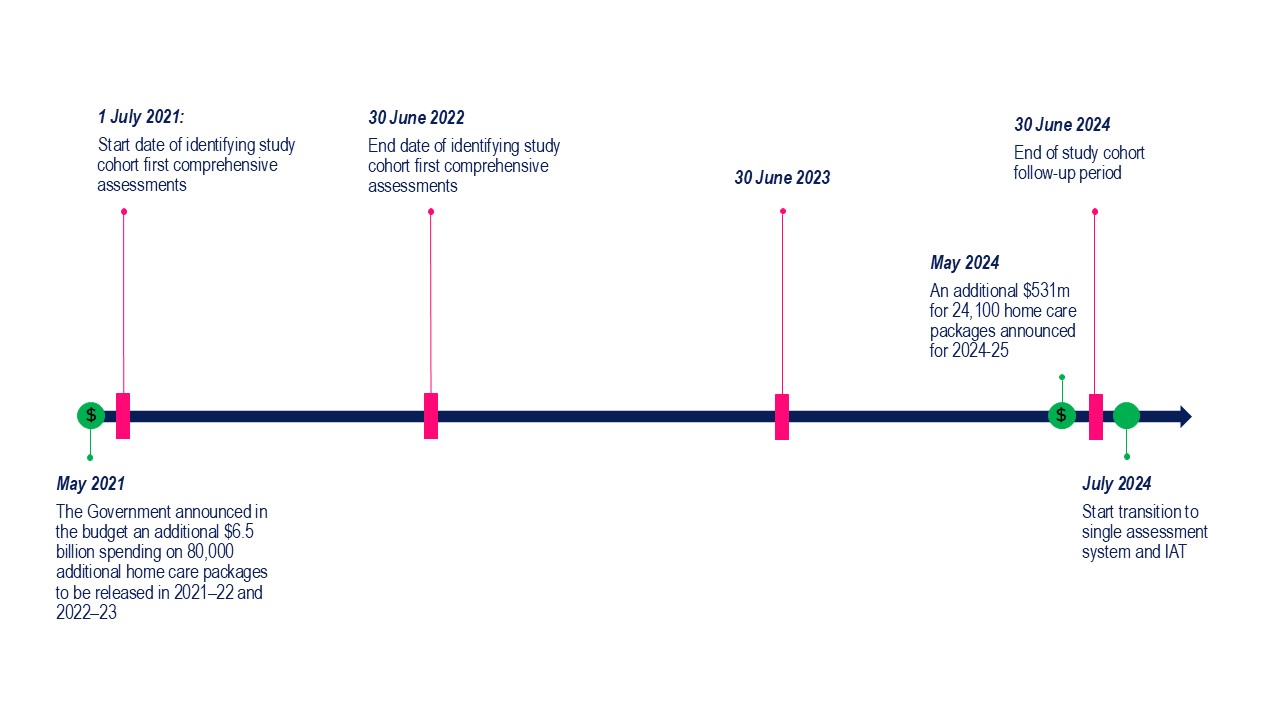
- In May 2021, just before the start of the study period, an additional 80,000 home care packages were announced, to be released over the 2021–22 and 2022–23 financial years. This increased the supply of places available for those approved for home care during the study period.
- The study period ended at 30 June 2024, just before the beginning of the change in aged care eligibility assessments, from the National Screening and Assessment Form (NSAF) to the Integrated Assessment Tool (IAT).
To align with the Report on Government Services reporting, the cohort analysed in this report includes all people aged 65+ and First Nations people aged 50-64. The analysis that follows looks at service outcomes for people, split into three groups, namely those approved for:
- home care package only,
- permanent residential aged care only, or
- home care package and permanent residential aged care.
The number of people in each approval group, and the number in each group who received their approved service before 30 June 2024 is shown in Figure 2.
- The largest group was those approved for both a home care package and permanent residential aged care (45%), while:
- Around 1 in 3 (32%) were approved for home care only.
- Around 1 in 4 (23%) were approved for permanent residential aged care only.
- Among those approved for a home care package only, 80% received their approved service.
- Among those approved for both a home care package and permanent residential aged care, 83% received their approved service.
- Of those approved for ‘both a home care package and permanent residential aged care’ who had received an approved service by 30 June 2024:
- 4 in 5 (80%) received a home care package at the approved level,
- 1 in 5 (20%) entered permanent residential aged care.
- Among those approved for permanent residential aged care only, 68% received their approved service.
Figure 3 shows the service outcomes for individuals in the study cohort at 30 June 2024. The outcomes at the end of the study period were as follows:
- Over 3 in 4 (79%) received the approved service.
- Over 1 in 6 (18%) received another service, either at a lower level or different from first approved.
- A small percentage (2.2%) died prior to or on 30 June 2024 without receiving a home care package, permanent residential aged care or home support
- A small percentage (1.3%) did not receive an aged care service in the analysis period.
Figure 3: Aged care service use outcomes following first comprehensive assessment approvals in 2021–22, up to 30 June 2024
The figure shows the proportion of people in each of the 3 groups who received their approved service during the study period. Most received their service in this time.
- Of those approved for ‘both a home care package and permanent residential aged care’
- Over 4 in 5 (83%) had received their approved care service
- Almost all (97%) had received an aged care service, including home support.
- Of those approved for a home care package only
- 4 in 5 (80%) had received their approved home care package
- almost all (98%) had received any aged care service, including home support.
- Of those approved for ‘permanent residential aged care only’
- Almost 7 in 10 (68%) had received permanent residential aged care
- Over 9 in 10 (93%) had received any aged care service, including home support.
Individuals approved for a home care package, permanent residential aged care, or both in 2021–22 are represented in the left column. The aged care service use outcomes at 30 June 2024 are represented on the right. Each individual was assigned to only one outcome, so any lower-level services received before their final service outcome are not captured in this figure.
The connecting lines represent the flow of people from type of approval to aged care service use outcome. The width of the lines represents the number of people moving from approval to outcome. Aged care service use outcomes were grouped 1- 7 as follows:
- people who received their approved aged care service,
- people who received an interim home care package (i.e. home care package at a lower level),
- people who received permanent residential aged care, but not home care. This outcome was only applied for people initially approved for ‘a home care package only’ (they must have undertaken a further comprehensive assessment to receive approval for permanent residential aged care),
- people who received home support but no home care package or permanent residential aged care,
- people who died without receiving a home care package, permanent residential aged care, or home support,
- people who had not yet received a home care package, permanent residential aged care, or home support, but had a further comprehensive assessment,
- people who had not yet received a home care package, permanent residential aged care, home support, or a further comprehensive assessment (censored or timed out).
For more information on aged care service use outcomes, see the Technical notes.
Elapsed time from assessment to receipt of approved service
Key Messages
- The median elapsed time from approval in 2021–22 to receipt of approved service was 176 days, or around 6 months, for both those approved for home care only and those approved for both home care and permanent residential aged care.
- The median elapsed time from approval in 2021–22 to receipt of approved service was 53 days, or less than 2 months, for those approved for permanent residential aged care only.
- The shortest median elapsed time (15 days) was for those approved for home care only in 2021–22 with a high priority assigned at assessment.
Several circumstances may contribute to the length of elapsed time between approval for an aged care service and receipt of that service, including:
- time spent waiting for a service to become available,
- time spent organising financial, guardianship and other arrangements necessary to accept care, and
- choosing not to accept an offered service.
The elapsed times calculated using the available linked data cannot differentiate between these elements.
The median elapsed time is the length of time that falls in the middle of all elapsed times for each approval group who received their approved care service, so that half of the group had a shorter elapsed time and half had a longer elapsed time. The median times reported here are based only on those who received their approved service before 30 June 2024. If the cohort was able to be followed for longer, and more people received their approved service after 30 June 2024, the calculated median values would be higher.
Figure 4: Median elapsed time from approval in 2021–22 to receipt of service at the approved level by 30 June 2024
The median elapsed time to receive approved services by 30 June 2024 is shown for each approval group. Around 79% of people received their approved service in the study period.
- The median elapsed time from approval for home care only, and for home care and permanent residential care to receipt of approved service was 176 days, or around 6 months.
- The median elapsed time from approval for permanent residential aged care to receipt of approved service was shorter at 53 days, or around 7.5 weeks.
- The interquartile range is marked for each group with a black bar, which includes 50% of all elapsed times among those who received their approved service. 25% of elapsed times were shorter than those included in this range, and 25% of elapsed times were longer.
The priority level assigned at assessment resulted in differences in elapsed time to receipt of service, as shown in Table 1. According to previous guidance from the Department of Health, Disability and Ageing, the default priority is medium priority with only a small percentage of people who are at immediate risk being approved as high priority. For the group approved for both home care and permanent residential aged care, the priority level for residential care was used, because it is a higher level of care than home care.
Table 1: Elapsed time to receipt of approved service by care priority level, for approvals in 2021-22 and services received by 30 June 2024
Median elapsed time (days) by priority level |
'HCP and PRAC' approval group* |
'HCP only' approval group |
'PRAC only' approval group |
|
1-Low |
181 | 160.5 | 63 |
| 2-Medium | 161 | 181 | 50 |
| 3-High | 76 | 15 | 52 |
| Total | 176 | 176 | 53 |
Note: HCP: home care package; PRAC: permanent residential aged care
* For those approved for ‘both a home care package and permanent residential aged care’, the priority level presented in this table relates to the priority level assigned for entry into permanent residential aged care (the higher care needs service), which is different from the priority level assigned for home care package in the same assessment.
Source: https://www.gen-agedcaredata.gov.au/
- Among those approved for both a home care package and permanent residential aged care in 2021–22:
- Around 3 in 4 (76%) had a low priority assigned for permanent residential aged care.
- Those with a high priority had a shorter median elapsed time (76 days) for their approved service, compared to those with medium priority (161 days).
- Among those approved for a home care package only in 2021–22, the difference was more pronounced:
- Those with high priority had a median elapsed time of only 15 days.
- The median elapsed time was 181 days (about 6 months) for those with medium priority.
- Among those approved for permanent residential aged care only in 2021–22, only a small difference was seen:
- Those with high priority had a median elapsed time of 52 days (or less than 2 months).
- The median elapsed time was 50 days (also less than 2 months) for those with medium priority.
Receipt of interim care while waiting for approved service
- Among all three approval groups most people (86% or 101,700 out of 118,100) received either a lower-level home care package or home support while waiting for their approved service.
- Of the almost 91,500 people approved for either a home care package only or both a home care package and permanent residential aged care in 2021–22:
- about 6,300 (6.9%) received a lower-level home care package before going on to receive their approved service.
- The median elapsed time was 131 days (or over 4 months) to receive a lower-level home care package before going on to receive the approved service (interquartile range: 1–215 days).
- Over 1 in 3 (36% or 33,200) had a median elapsed time of over 6 months for either a lower-level home care package only or for their approved care service.
Characteristics associated with elapsed time to receipt of approved care service
Key messages
- The median elapsed time to receipt of service among both men and women aged 65+ who were approved for only permanent residential aged care in 2021–22 became shorter with increasing age.
- Younger age groups were associated with:
- shorter elapsed time to receipt of approved service among those approved for a home package only in 2021–22,
- longer elapsed time for those approved for permanent residential aged care only in 2021–22 (compared to those aged 90+).
- Having dementia was associated with shorter elapsed time to receipt of approved service for those approved for either permanent residential aged care only, or both a home care package and permanent residential aged care in 2021–22 (compared to those with no dementia).
Understanding who experiences longer elapsed times to receiving an approved care service can help identify barriers and opportunities to improve care delivery to those most in need. Figure 5 shows the median elapsed time from service approval to service receipt, broken down by age group and sex for people first approved for aged care services in 2021–22.
Figure 5: Elapsed time from service approval in 2021–22 to receipt of the service at the approved level by 30 June 2024, by age group and sex
Median wait times are shown by approval group. Across all age groups, waits were shortest for people who received permanent residential aged care only.
- Median elapsed times were similar for men and women aged 65 and over who were approved for both a home care package and permanent residential aged care in 2021–22.
- Elapsed times were more varied below the age of 65, most likely due to smaller numbers in these age groups.
- Among both men and women approved for permanent residential aged care only in 2021–22, median elapsed times decreased with increasing age.
To examine which demographic and clinical features most strongly impacted elapsed time to receiving an approved aged care service, multivariate competing risk modelling was undertaken (Fine and Gray 1999). This analysis quantifies the effect of each factor on the incidence of receiving the approved level of care at any point in time after approval and before a competing risk event, while controlling for other factors. A higher incidence is associated with a shorter elapsed time, and a lower incidence with a longer elapsed time. More information about the data and methods used here are available in the Technical notes.
Figure 6: Factors associated with elapsed times for those who had their first approved comprehensive assessment approved in 2021-22, by approval groups
Event rate ratios show whether people with different demographic or clinical characteristics are likely to receive an approved service sooner or later than a reference group.
- Younger age groups were associated with:
- shorter median elapsed time to receipt of approved service among those approved for a home care package only
- longer elapsed time for those approved for permanent residential aged care only (compared to those aged 90+).
- Being First Nations was associated with longer elapsed time among those approved for permanent residential aged care (compared to non-indigenous).
- High priority level was associated with shorter elapsed time for all approval groups (compared to low priority level).
- Having dementia was associated with shorter elapsed time for those approved for either permanent residential aged care only, or both a home care package and permanent residential aged care (compared to those with no dementia).
- Being assessed in hospital was associated with longer elapsed time among those approved for a home care package only (compared to those not assessed in hospital).
- Living alone was associated with shorter elapsed time for those approved for permanent residential aged care only (compared to those not living alone).
- Living outside of metropolitan areas and regional centres (MM 3 – 7) was associated with longer elapsed time for those approved for permanent residential aged care only (compared to living in a metropolitan area or regional centre).
- Event rate ratios compare each group with a reference group (reference line at 1). Higher values of event rate ratio indicate a stronger association.
- Values greater than 1 indicate an association with shorter elapsed time to receipt of approved service, while a value less than 1 indicates association with longer elapsed time, after controlling for other factors. In Figure 8 the scale is reversed, so that association with shorter elapsed time is on the left, and longer elapsed time on the right.
- 95% confidence intervals indicate precision; results are statistically significant when the interval does not cross 1.
Comparison to previous cohorts and other reported numbers
Key messages
- The number of individuals approved for a home care package, permanent residential aged care, or both in their first comprehensive assessment in 2021–22 was around 118,100, which was 14% higher than the number approved in 2017–18 (around 104,000).
- The number of individuals approved for home care only in their first comprehensive assessment in 2021–22 was around 38,200, which was 88% higher than the number approved in 2017–18 (around 20,300).
- Median elapsed time for the home care only group dropped from 472 days (~15.5 months) in the 2017–18 cohort to 176 days (~6 months) in the 2021–22 cohort.
- Other reports based on more recent data indicate an increase in elapsed times to receive aged care services over the last few years, however, estimates are not directly comparable to this report as they are derived using different reference time points in the service pathway.
This section compares the number of people in each approval group, the proportion of people who received a care service at the approved level, and median elapsed times to receipt of approved service across the following three reporting periods:
- The initial report, Timeliness of access to aged care services in Australia 2023, which examined elapsed times for individuals approved for an aged care service in 2017–18 and followed up to 30 June 2020, and
- Timeliness of access to aged care services in Australia 2024, which examined elapsed times for individuals approved for an aged care service in 2019–20 and followed up to 30 June 2022, and
- The findings presented in the current report, which examines elapsed times for individuals approved for an aged care service in 2021–22 and followed up to 30 June 2024.
Key results from other recent reports examining elapsed times experienced by individuals before receiving aged care services are also presented for comparison. These reports contain more recent data, though they use different methods for measuring wait times, and are not based on linked datasets.
Figure 7: Number of people who had their first comprehensive assessment and number who received their approved care service, by approval group and comparing analysis periods
The number of people in each approval group, and the number who received the service, are shown for each year of approval from 2017-18 to 2021-22.
- The number of people in all three approval groups increased from 103,400 in the 2017–18 cohort to 118,100 in the 2021–22 cohort, an increase of 14%.
- The number of people approved for permanent residential care only increased from 22,600 in the 2017–18 cohort to 26,600 in the 2021–22 cohort, an increase of 18%.
- The number of people approved for a home care package only increased from 20,300 in the 2017–18 cohort to 38,200 in the 2021–22 cohort, an increase of 88%.
- The number of people approved for both a home care package and permanent residential aged care decreased from 60,500 in the 2017–18 cohort to 53,300 in the 2021–22 cohort, a decrease of 12%.
- Among those approved for only permanent residential aged care, the proportion who received their approved service within the study period was stable over the three cohorts at around 68%.
- Among those approved for only a home care package, the proportion who received their approved service within the study period increased from 60.5% for the 2017–18 cohort to 79.6% for the 2021–22 cohort.
Figure 8: Median elapsed times from approval to receipt of service, by approval group and comparing analysis periods
Median elapsed times to receive services are shown for each year of approval from 2017-18 to 2021-22.
- The median time to receipt of approved service decreased over time for those approved for home care only, from 472 days (about 15.5 months) for the 2017–18 cohort to 176 days (around 6 months) for the 2021–22 cohort.
- The median time to receipt of approved service decreased over time for those approved for home care and permanent residential care, from 342 days (about 11 months) for the 2017–18 cohort to 176 days (around 6 months) for the 2021–22 cohort.
- The median time to receipt of approved service increased over time for those approved for permanent residential care only, from 34 days in the 2017–18 cohort to 53 days in the 2021–22 cohort.
Figure 9: Median elapsed times to receipt of approved service and number of home care packages released by quarter, from 1 July 2017 to 30 June 2024
Median elapsed times to receive services for HCP and PRAC approval groups. Times for HCP only group decreased over the three reporting periods, coinciding with the release of more home care packages.
- Between Q4 in 2018–19 and Q4 in 2022–23 the number of home care packages released was mostly between 40,000 and 50,000 per quarter, an increase from earlier periods.
- The observed decrease in median elapsed time to receipt of approved home care packages occurred over the period where this higher than usual number of home care packages were released.
- From Q1 in 2023–24 to Q1 in 2025–26 the number of home care packages released was mostly between 30,000 and 35,000 per quarter.
The decrease in median elapsed time observed over the three iterations of this report is reflected in data reported in Table 14A.33 from the 2026 Report on Government Services (ROGS) (SCRGSP 2026). The ROGS table reports the median times from approval to commencement of a home care package (including a lower-level package) for people commencing a home care package in each financial year, so the results are not directly comparable to this report.
The ROGS table shows the median time from approval to commencement of a home care package decreasing between 2018–19 (447 days or about 14.5 months) to 2023–24 (118 days or about 4 months) before increasing again in 2024–25 to 245 days (~8 months).
The new Aged Care Act 2024 – Wait Times Report (DHDA 2026) reports elapsed time from application for an assessment through to receipt of service.
Because linked data were used in the current report, it was possible to observe how people moved between service types over time. This pathway context is important because approvals can involve multiple services: in the 2021–22 cohort, 45% of people were approved for both home care and permanent residential aged care in their first comprehensive assessment. For this combined-approval group, the first approved service received was most often home care (around 80%), indicating that many people’s journeys involve receiving home-based support, ahead of permanent residential aged care.
Department of Health, Disability and Ageing (DHDA) 2026. Aged Care Act 2024 – Wait Times Report: Residential care and Support at Home. Australian Government, Canberra, published 12 May 2026, accessed 14 May 2026. https://www.health.gov.au/resources/publications/aged-care-act-2024-wait-times-report?language=en
Fine J and Gray R 1999. A proportional hazards model for the subdistribution of a competing risk, Journal of the American Statistical Association, 99:496–509. https://doi.org/10.2307/2670170
McCallum J, Rees K and Maccora J 2018. Accentuating the positive: consumer experiences of aged care at home, National Seniors Australia, Brisbane, Queensland, accessed 19 June 2023.
Royal Commission into Aged Care Quality and Safety 2021. Final report: Care, dignity and respect, Royal Commission, Australian Government, accessed 19 June 2023. https://www.royalcommission.gov.au/aged-care/final-report
SCRGSP (Steering Committee for the Review of Government Service Provision) 2026, Report on Government Services 2026, Productivity Commission, Canberra, https://www.pc.gov.au/ongoing/report-on-government-services/community-services/aged-care-services/
Visvanathan R, Amare AT, Wesselingh S, Hearn R, McKechnie S, Mussared J & Inacio MC 2019. Prolonged Wait Time Prior to Entry to Home Care Packages Increases the Risk of Mortality and Transition to Permanent Residential Aged Care Services: Findings from the Registry of Older South Australians (ROSA). Journal of nutrition, health & aging 23, 271–280 (2019). https://doi.org/10.1007/s12603-018-1145-y
Where can I find more information
A detailed description of this report can be found in the Technical notes document.
For the previous version of this report, using the PIAC 2022 link map, see Timeliness of access to aged care services in Australia (released December 2024). For more PIAC link map analysis, see Pathways in aged care.
The PIAC 2024 link map is part of the National Aged Care Data Clearinghouse. A detailed account of how the linked dataset was created and prepared for reporting is available in the Pathways in Aged Care 2020: technical guide.
For more information on aged care in Australia, including elapsed time between aged care assessment approval and entry to aged care services, see:
- Aged Care Act 2024 – Wait Times Report
- Report on Government Services
- Report on the Operation of the Aged Care Act 1997
- Home care packages report
- Support at Home program data report
